
Your rollout process, enforced by the tool instead of remembered by a person
Most teams have a rollout process. It survives right up until the quarter is ending and someone flips a flag straight to 100% because they are confident. Define the phases once, and every feature walks through the same ones.
Process that lives in a wiki is process that erodes
The staged rollout everyone agrees to looks the same at every company: internal, then beta, then a slice of production, then everyone. It is a good process. Nothing enforces it.
Written down somewhere
- Someone skips the beta phase for a “tiny” change
- A flag reaches production without the internal phase — that person was on holiday
- Two engineers roll out in two different orders; neither is wrong exactly
- The retrospective concludes the team should follow the process more carefully
Built into the pipeline
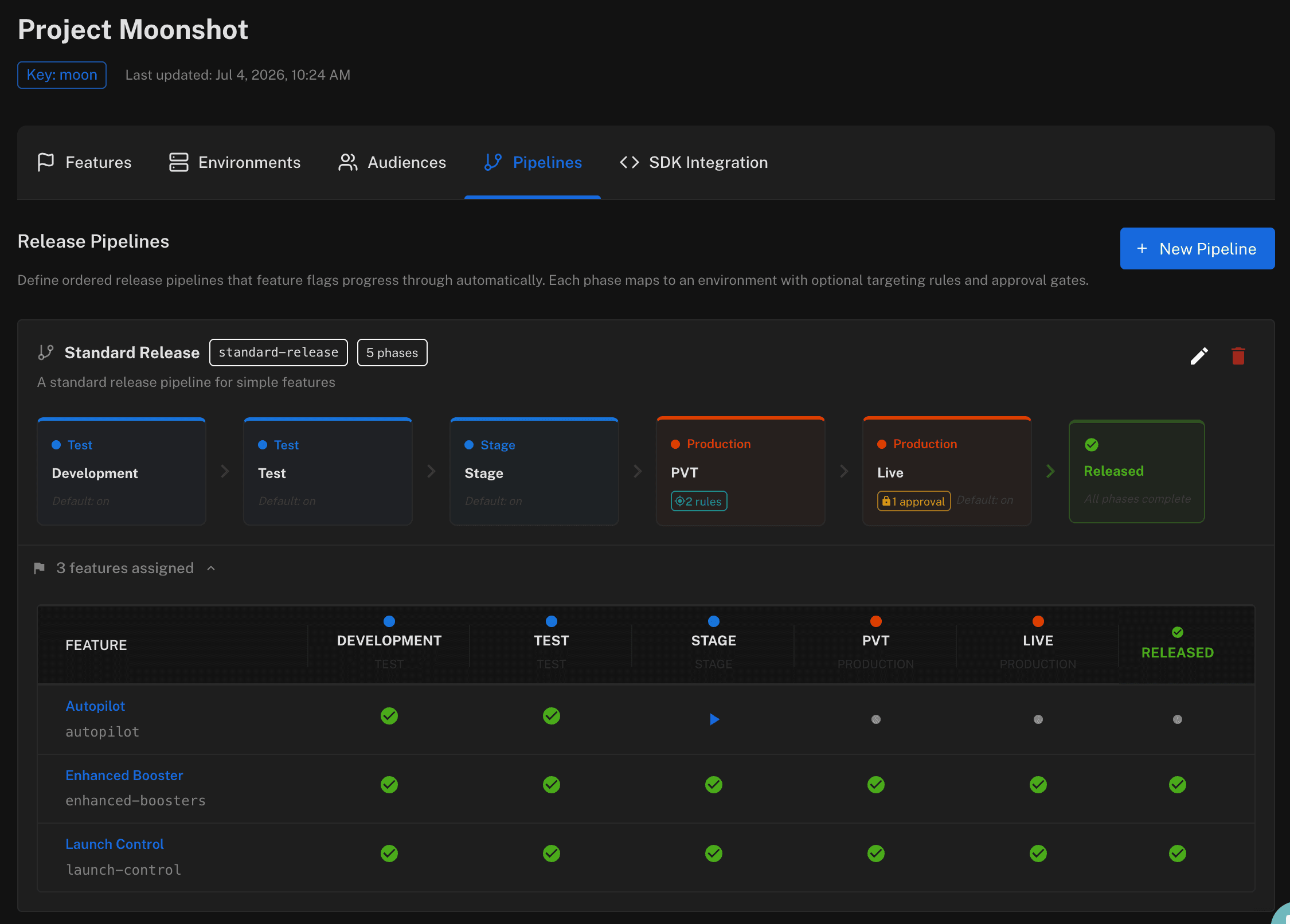
- Phases are ordered, and a feature advances one at a time
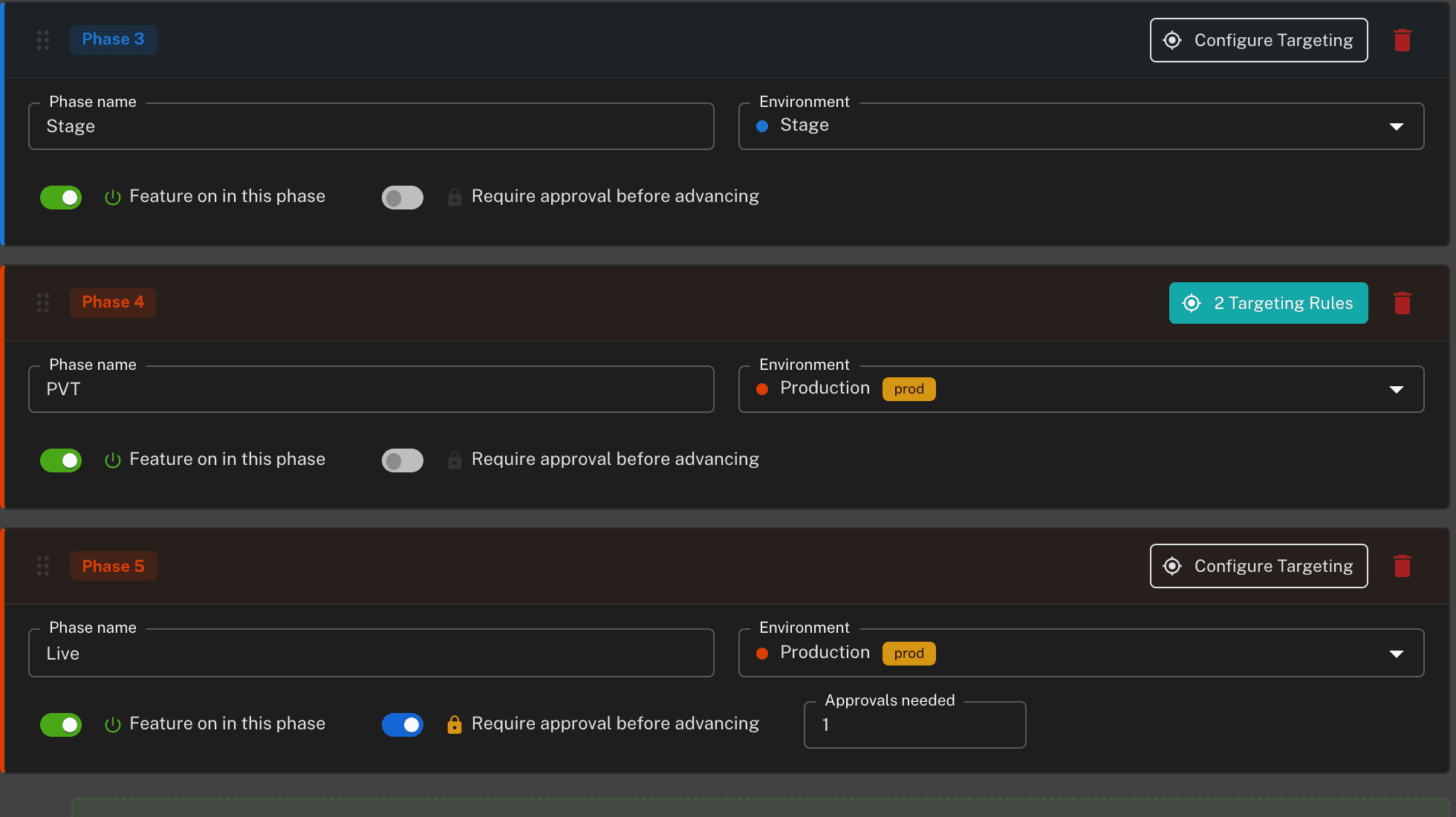
- Each phase applies its own default targeting on advance
- Sensitive phases require approval before the change applies
- Every advance and approval lands in the audit trail
“Follow the process more carefully” is not a mechanism.
Phases
A phase is more than a label on a board
Production verification defaults to staff
Internal accounts only, applied automatically when the feature lands in that phase.
Go-live defaults to everyone
Advancing between the two applies those rules — so “we always check it with our own accounts first” becomes what the tool does when you click advance.
Approvals
Gates only where they are worth the friction
Dev and test stay a single click
Nobody needs sign-off to try something in test.
Customer-facing phases need sign-off
One or more approvals before the change applies. Write permissions are role-based and enforced server-side.
Everything is recorded
Who advanced it, who approved it, and when.

One board, one answer to “where is that feature?”
Less dramatic than the governance case, and probably matters more day to day.
The pipeline board
Every assigned feature and the phase it sits in. A product manager answers their own question without asking an engineer.
Jira app
Live flag status on the ticket itself, delivered as an Atlassian Forge app.
Slack notifications
The status of a release stops being tribal knowledge held by whoever shipped it.
Pipelines, approvals, the audit trail and Google sign-in are on every plan, including Free — the clearest difference between us and the rest of the market. See why teams pick Featureflow and the LaunchDarkly comparison.
Frequently asked questions
What is a release pipeline in a feature flag tool?
An ordered set of phases a feature moves through on its way to production — development, test, staging, production verification, go-live. Each phase targets an environment and carries default targeting rules applied on advance. Every feature follows the same agreed path instead of depending on who is driving.
How is this different from my CI/CD pipeline?
A CI/CD pipeline moves code. A release pipeline moves the decision to expose that code. The two run at different speeds on purpose — your build can reach production several times a day while a feature sits in an internal-only phase.
Do approvals slow down day-to-day development?
They only apply where you put them. Gates are configured per phase, so development and test stay a single click while phases touching real customers require sign-off. Roles are enforced server-side, so the gate is real rather than a hidden button.
Is this an enterprise feature?
No. Release pipelines, approval workflows and the audit trail are on every plan, including Free. Across the rest of the market these are the capabilities most often held back for the top tier, which asks small teams to choose between governance and budget.
Can I see where every feature currently is?
Yes. The pipeline board shows every assigned feature's position across the phases, and each feature's overview shows its current phase and what comes next. Advancing is a single click, and every advance and approval is recorded with who did it and when.
Does it help with SOC 2 or ISO 27001?
It gives you the evidence. Those frameworks need demonstrable change control over what reaches production, and feature flags are exactly the kind of production change a deployment-focused control set misses.
Set up your pipeline once, then stop arguing about it
Free forever tier with pipelines, approvals and the audit trail included. No credit card.
What else Featureflow solves
Kill switch
Turn a bad feature off without shipping a hotfix
Progressive rollout
Reach 1% of users before you reach all of them
Approvals & audit
Answer 'who changed production?' without an enterprise contract
Remote config
Change settings without a deploy or an app store review
Mobile releases
Update the app your users already installed
A/B testing
Split traffic and record what each variant actually did