
Answer “who changed production?” without an enterprise contract
Your deploy pipeline is reviewed, logged and approved. Then somebody flips a flag in a browser tab and your product changes for every customer — no pull request, no build, often no record.
The control gap flags quietly open
Every control your organisation built around production change is attached to the deployment. Take the change out of the deployment and it walks straight past all of it.
Flags without governance
- “When did this turn on and who did it?” is a guess and a Slack search
- A whole class of production change happens outside the process you just described
- Permissions are a hidden button; the REST API is still right there
- Governance is quoted as an enterprise add-on
Flags with Featureflow
- Approval required before the change applies in a given environment
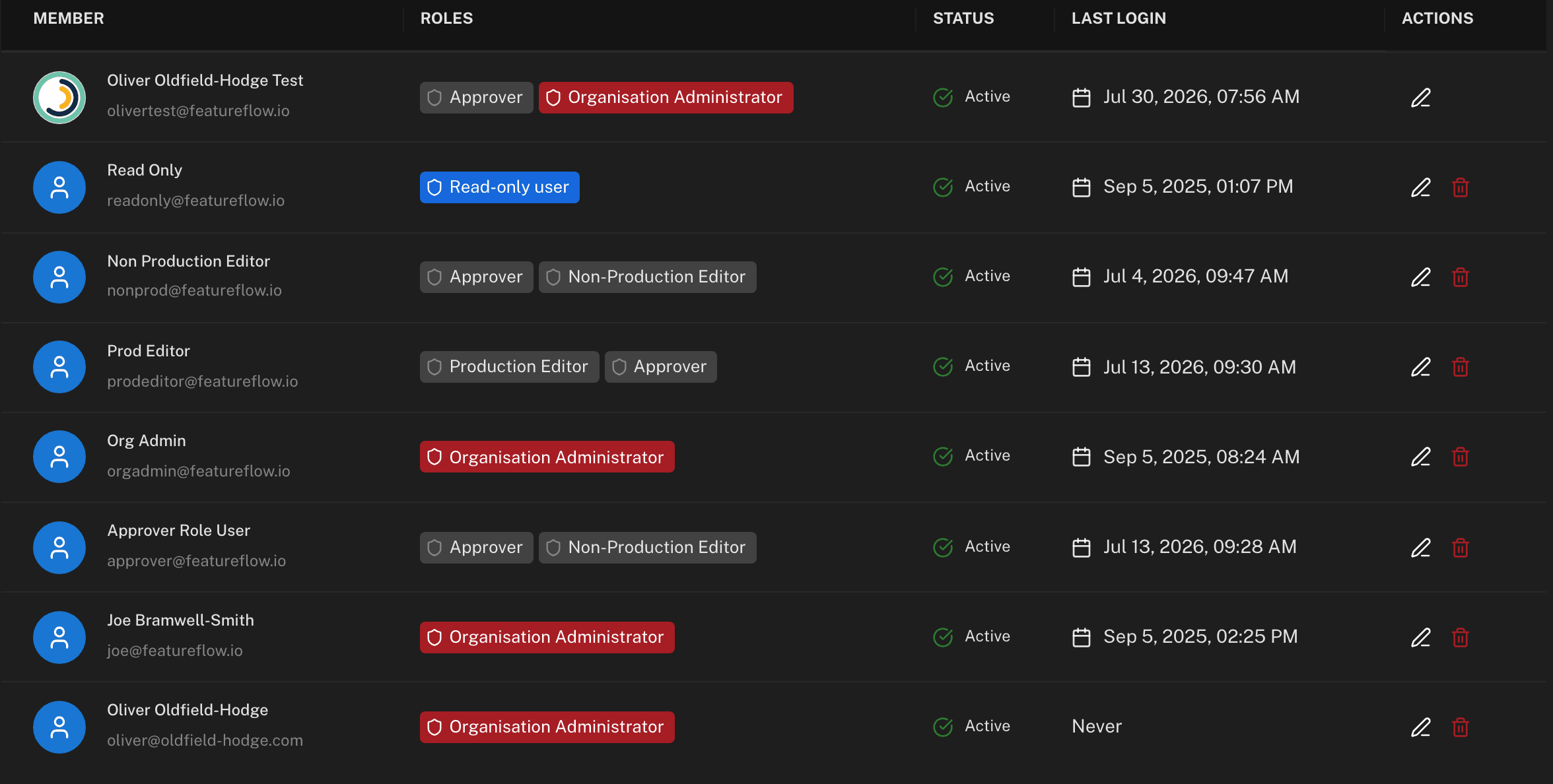
- Roles enforced server-side, on every entry point
- A record of who changed what, where and when
- All of it on every plan, including Free
Approvals
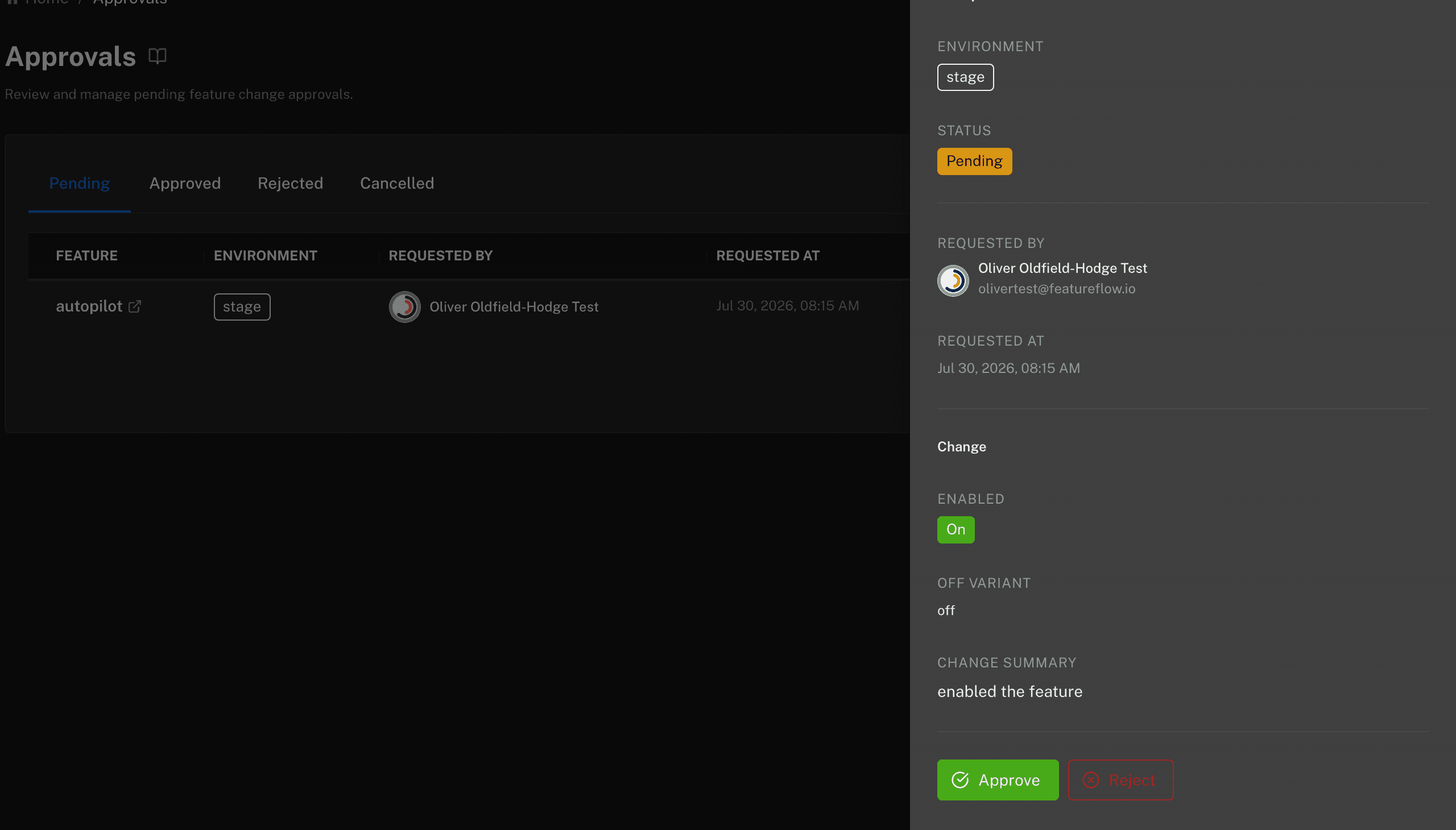
Approval where it earns its friction
Dev and test stay a single click
Nobody should need sign-off to try something in test.
Production can require one or more approvals
Gates also attach to release pipeline phases, so review happens as a feature moves toward real customers rather than on every edit.
A permission implemented by hiding a button in the dashboard does nothing about the REST API — which is right there, documented, with a personal access token attached to it.
Permissions
Permissions that survive contact with the API
The dashboard
Where most changes start.
The public REST API
Scripts and CI jobs using personal access tokens.
The MCP server
An AI assistant driving flags gets the same model. One model, every entry point.
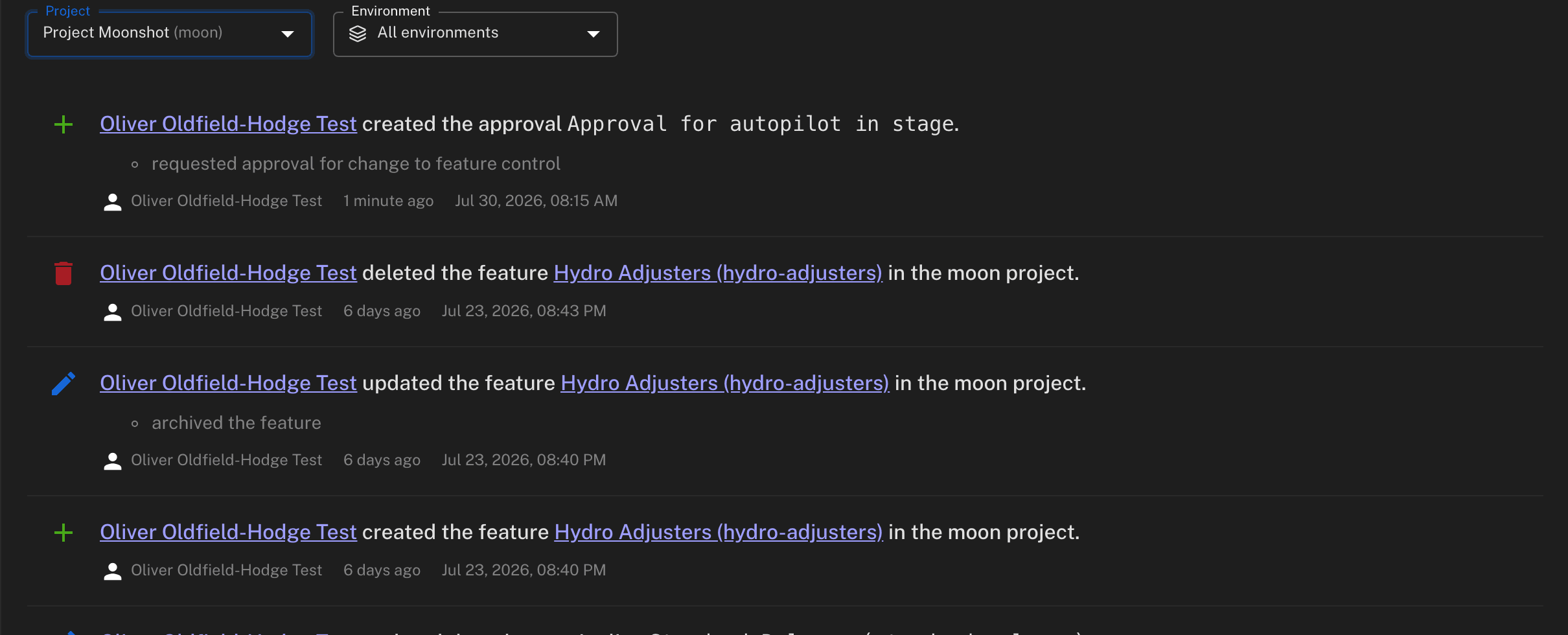
A record you can hand to an auditor
In an incident review this turns the timeline from reconstruction into a lookup. In an audit it is the evidence for a control you would otherwise struggle to demonstrate.
Attributable
Every change carries the identity behind it.
Reviewable
What changed, in which environment, and when.
Reversible
Production configuration changes can be traced and undone.
Approvals, audit trails and SSO are the three capabilities most commonly held back for the top tier across this market — offering a team of eight a choice between release governance and their budget. We do not offer that trade. The full picture is on why teams pick Featureflow, and the longer write-up is in feature flags, compliance and audit trails.
Frequently asked questions
Are approvals and audit trails really on the free plan?
Yes. Approval workflows, role-based write permissions, the audit trail, release pipelines and Google sign-in are on every plan, including Free. These are the controls that make flags safe to run, and a small team needs them as much as a large one.
How do approvals work?
An environment can require approval before a flag change takes effect there. The change is proposed, it waits, and it applies once approved. Because it is set per environment, development and test stay fast while production gets a second pair of eyes.
Is the permission model enforced server-side?
Yes. Write permissions are role-based and enforced on the server, not by hiding controls in the dashboard. A control that only exists in the UI is not a control, because the REST API is still there.
What does the audit trail record?
Who changed what, where, and when — the change, the environment it applied to, and the identity behind it. That covers the incident question and the auditor's question.
Does Featureflow support SSO?
Google sign-in is available for account access on every plan. If your organisation requires SAML-based enterprise single sign-on, talk to us about the Enterprise plan.
Does this make us SOC 2 or ISO 27001 compliant?
No tool makes you compliant on its own — compliance is about your whole control environment, and you should confirm specifics with your auditor. What you get is the evidence for one control flag-using teams commonly find missing: change control over production configuration that never went through a deployment.
Get change control over your flags today
Approvals, roles and the audit trail are on the free tier — no credit card, no sales call.
What else Featureflow solves
Kill switch
Turn a bad feature off without shipping a hotfix
Progressive rollout
Reach 1% of users before you reach all of them
Release pipelines
The rollout process runs itself instead of being remembered
Remote config
Change settings without a deploy or an app store review
Mobile releases
Update the app your users already installed
A/B testing
Split traffic and record what each variant actually did