
A DevCycle Alternative That Doesn't Meter Your Users
DevCycle doesn't charge per seat on any plan, which is a genuinely good default - but its plan tiers are still sized by client-side monthly active users, so a consumer-facing app's bill can grow as its user base does. Featureflow's plans are flat regardless of end-user count: Free, Team at $99/month, Business at $399/month, with the only metered number being SDK requests, treated as a fair-use guideline rather than a billing trigger.
DevCycle is a strong choice if you want an OpenFeature-native SDK and free seats are the main thing you're optimizing for. Featureflow is the better fit if you want the bill to stay flat as your product's user base grows, and approval workflows on a self-serve plan rather than Enterprise-only.
What DevCycle is good at
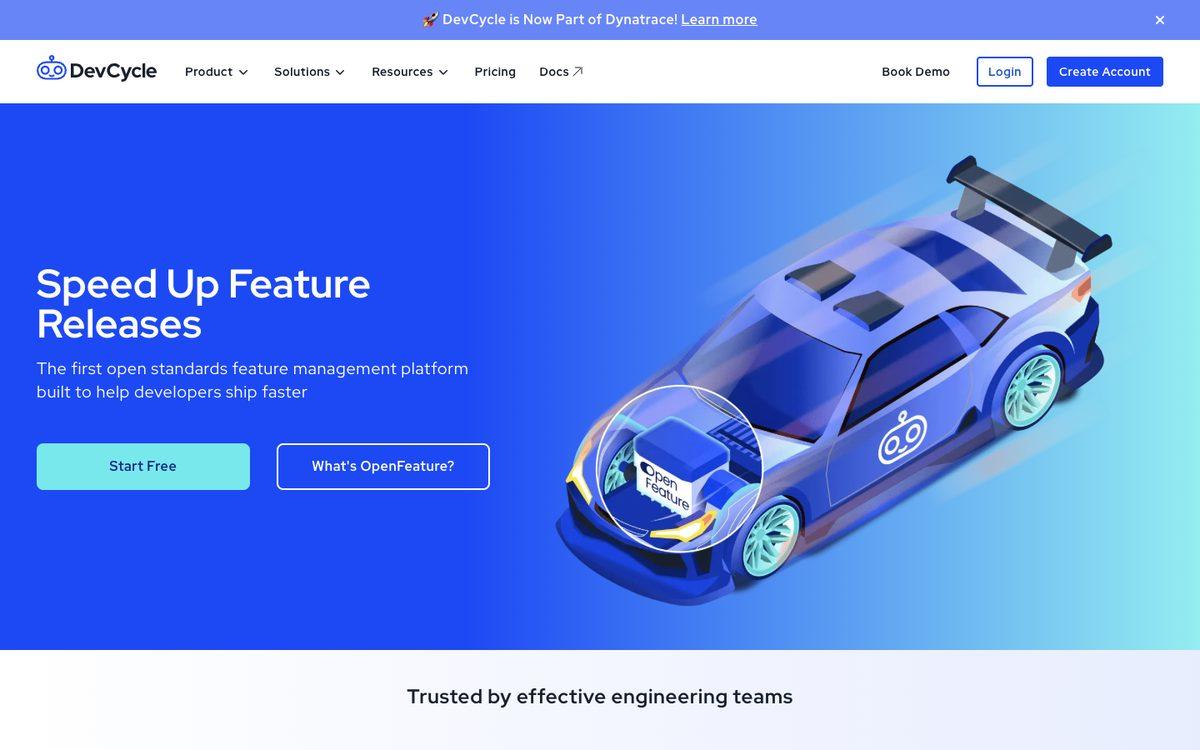
DevCycle is built around OpenFeature, the CNCF's open standard for feature-flag SDKs, rather than a proprietary API - a real advantage if you want to avoid vendor lock-in at the SDK layer or plan to run multiple flag providers side by side. Every plan, including its free tier, has unlimited seats and unlimited flags, and it offers Local Bucketing SDKs and an SDK Proxy that keep flag evaluation close to your infrastructure while DevCycle's dashboard and control plane remain managed.
If OpenFeature-native SDKs and free seats on every tier are what you're optimizing for, and you're comfortable with a bill that scales with client-side MAU, DevCycle is a reasonable, well-built option. One thing to weigh: in January 2026 the DevCycle platform became part of Dynatrace, so its roadmap now sits inside a larger observability company.
Why teams pick Featureflow instead
DevCycle's plan tiers are still sized by client-side monthly active users - free seats don't mean a flat bill, because the meter moves to your end users instead. Featureflow's flat monthly price with unlimited seats doesn't move with your product's user base at all; the only metered number is SDK requests, with generous allowances (1M/month on Free, 10M on Team, 100M on Business) that are a fair-use guideline, never a tripwire.
Approval Workflows are also DevCycle's Enterprise tier only. Featureflow's release pipelines and approval workflows are on Business at a flat $399/month - self-serve, no Enterprise conversation required to get a second person's sign-off before a production change.
Side by side
| Featureflow | DevCycle | |
|---|---|---|
| Rollout control | Targeting rules and percentage rollouts on every plan, including Free. | Targeting and percentage rollouts, with unlimited flags and seats on every plan, including free. |
| Release pipelines & approvals | A defined pipeline of phases a flag moves through, with approval workflows on Business - self-serve, flat $399/month. | Approval Workflows require every change to be reviewed and approved by a Publisher or Owner - but this is an Enterprise-only feature. |
| Runtime config | JSON value on every flag variant, not just booleans and strings. | JSON variable type supported on flags. |
| SDK coverage | Server: Node.js, Java, Go, Python, Ruby, .NET. Client: browser JavaScript, React, React Native, native iOS, native Android. | OpenFeature-native SDKs across popular server and client languages, plus Local Bucketing SDKs and an SDK Proxy option for keeping evaluation local. |
| Hosting model | Hosted SaaS - nothing to run or patch yourself. | Hosted, with a hybrid option (Local Bucketing SDKs / SDK Proxy) that keeps evaluation on your infrastructure while the dashboard and control plane stay managed by DevCycle. |
| Pricing model | Flat monthly plan tiers - no MAU meter at all, so a successful product launch never changes the bill. | Unlimited seats on every plan, but plan tiers are sized by client-side monthly active users - Free up to 1,000 MAU, Business up to 100,000 MAU - so the bill can grow with your end-user base. |
| AI agent tooling | MCP server plus published agent skills (setup, add-flag, targeting, experiments, cleanup) for AI coding assistants. | An official DevCycle MCP server for shipping and managing flags safely from AI coding agents. |
| Integrations | Full two-way Jira integration (see flag status in Jira, search your Jira tickets from within Featureflow), Slack, Datadog, Grafana, outbound webhooks, REST API. | Slack, Jira (linking tickets to features), Datadog (enriching RUM data with flag evaluations), and outbound webhooks. |
DevCycle facts verified 19 Sep 2026 against DevCycle's approval workflows docs, self-hosting docs, Slack integration docs, its MCP server announcement, and DevCycle's pricing page. Featureflow pricing is on our pricing page.
Pricing models compared

Per DevCycle's own pricing page, its Free plan covers up to 1,000 client-side MAU with unlimited seats and flags; Business includes up to 100,000 MAU and 500,000 events, billed monthly with a discount for annual billing, adding AI-generated summaries, audit logging, roles and permissions, and stale-flag detection - but not Approval Workflows or SSO. Overage beyond the included MAU on Business is billed per additional block of MAU. Enterprise is custom, uncapped on MAU, and is the only tier with Approval Workflows and SSO/SAML - see DevCycle's pricing page for current rates.
So DevCycle's 'free seats' framing is accurate but incomplete: seats don't cost anything, but the plan tier - and the price - is still set by how many end users your app has. Featureflow's flat tiers don't have an MAU dimension at all; Team and Business are the same $99 and $399 whether your product has 100 users or 100,000.
Governance and release workflow

DevCycle's Business plan adds audit logging and roles and permissions but explicitly excludes Approval Workflows and SSO - both require moving to custom-priced Enterprise. That means a mid-sized team paying for DevCycle's mid tier still can't require a second person's sign-off before a flag change ships. Featureflow's release pipelines and approval workflows are on Business at a flat $399/month, self-serve, with approvals included rather than reserved for Enterprise.
Audit logging without an approval requirement tells you what happened after the fact; it doesn't stop a misconfigured rollout before it ships. If the goal is genuinely preventing a bad change - not just being able to explain one later - the approval step is the part that matters, and it's the part DevCycle reserves for its highest, custom-priced tier.
Runtime config
DevCycle supports a JSON variable type on flags, similar in shape to Featureflow's JSON configuration value on every flag variant - both let a single flag carry structured config rather than a plain toggle. The bigger architectural difference is evaluation location: DevCycle's Local Bucketing SDKs and SDK Proxy option let you run evaluation on your own infrastructure while DevCycle's dashboard and control plane stay managed, which OpenFeature-standardization-minded teams may value. Featureflow's client SDKs instead pre-evaluate server-side and ship a compact, CDN-cached result to the device, so there's no local bucketing component to run yourself.
Running your own Local Bucketing SDK or SDK Proxy buys lower evaluation latency and keeps rule data on your infrastructure, at the cost of another component for your team to deploy, monitor and keep patched. If that operational trade-off isn't something you're looking to take on, a CDN-delivered result gets you most of the latency benefit without the extra piece of infrastructure.
When DevCycle is the better choice
If standardizing on the OpenFeature SDK specification is a hard requirement - so you can swap providers without touching evaluation code, or run more than one provider side by side - DevCycle's OpenFeature-native design is a genuine strength Featureflow doesn't match today. Teams for whom that portability matters more than flat, MAU-independent pricing should weigh it seriously.
You want the bill to stay flat regardless of your end-user count, and approval workflows without paying for Enterprise.
Standardizing on the OpenFeature SDK spec is a hard requirement, or you want free seats on every tier and are comfortable with a bill that scales with client-side MAU.
Frequently asked questions
Does Featureflow charge by monthly active users like DevCycle?
No - Featureflow's plans are a flat monthly price regardless of your end-user count. The only metered number is SDK requests, and passing an allowance never cuts a flag off.
Do I need an Enterprise plan for approval workflows, like DevCycle?
No - Featureflow's release pipelines and approval workflows are on the Business plan at a flat $399/month, self-serve. DevCycle's Approval Workflows are Enterprise-only.
Is Featureflow OpenFeature-native like DevCycle?
Not today - Featureflow ships its own SDKs for Node.js, Java, Go, Python, Ruby, .NET, browser JavaScript, React, React Native, iOS and Android. If OpenFeature compatibility is a hard requirement, weigh that against DevCycle's SDK design.
What does DevCycle's Business plan include, and does it have approvals?
Per DevCycle's pricing page, Business includes up to 100,000 client-side MAU and 500,000 events, plus AI-generated summaries, audit logging, and roles and permissions, with metered overage beyond the included MAU. It does not include Approval Workflows or SSO - both require Enterprise. Featureflow's Business plan is a flat $399/month with approvals included and no MAU dimension.
Does DevCycle's free plan have a user limit?
Yes - DevCycle's free plan covers up to 1,000 client-side MAU, with unlimited seats and flags. Featureflow's Free plan has no MAU limit at all; its limits are 5 seats, 1 project and 2 environments.
Try pricing that doesn't move with your user base
Free forever, no credit card - and every new account starts with a 14-day full Business trial, including release pipelines and approvals. Talk to us about your migration.
Start Now (Free)